Homeowners often ask about resurfacing when the real answer is a liner, and the reverse. The two jobs are not interchangeable, because they apply to different pool construction. Here is how to tell which one you are dealing with.
Which finish do you have?
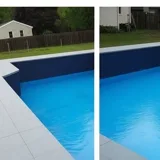
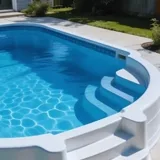
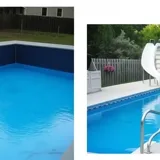
- Vinyl liner pool: a smooth, flexible liner with a visible edge or bead at the waterline, and no plaster texture. Most above-ground pools and many inground pools.
- Concrete pool: a hard plaster or aggregate surface, often with a textured feel and sometimes visible trowel marks.
- Fibreglass pool: a moulded one-piece shell, usually with a gel-coat finish and no waterline bead.
A vinyl pool gets a liner. A concrete or fibreglass pool gets resurfaced. No contractor should be quoting you the other one.
Cost comparison
| Job | Typical published cost |
|---|---|
| Above-ground liner replacement | $700 - $2,500 |
| Inground liner replacement, standard rectangular | $3,000 - $5,500 (or $4,000 - $6,500 with refill water) |
| Large or custom liner | $6,500 - $9,000 and up |
| Concrete or fibreglass resurface | $10,000 - $30,000 and up |
A liner replacement is a repair. A resurface is closer to a rebuild, which is why the gap is so wide.
What a new liner does and does not fix
It restores the water-holding surface, refreshes the look, and lets you change colour or print. It does not fix a failing floor base, corroded wall panels or drainage that pushes groundwater against the shell. Those are separate, itemised repairs, and they must be done while the pool is empty.
If you are being told the liner will solve a wall or floor problem, ask for that claim in writing and for the repair to be priced separately.
Timing, water and disruption
Either job empties the pool and returns it to service only after refilling and balancing. For a liner, published timings run 2 to 5 days for measurement, 5 to 15 days for fabrication or shipping, then a few days on site. Refill costs $60 to $350 on city supply or $400 to $900 trucked, and startup chemicals $80 to $200.
Frequently asked questions
Can I put a liner in a concrete pool?
Not as a normal liner replacement. Vinyl liners are made for walls and floors built to receive them. Concrete and fibreglass pools are resurfaced instead.
Is a liner cheaper than resurfacing?
Yes. Published figures put a standard inground liner replacement at $3,000 to $5,500, against $10,000 to $30,000 or more for a concrete or fibreglass resurface.
Which lasts longer?
A vinyl liner is a consumable, replaced every 5 to 15 years depending on type. Plaster and aggregate finishes also have a service life and need resurfacing later.